


In 2025-2026 middle school students across our network made exciting gains in ELA - and at AST and Cedar Middle Schools, the results were more than exciting, they were extraordinary. As we unpacked the data we spent time with a few members of both school teams, with the goal of answering the question: "What are teachers & leaders at these schools doing, and how do we replicate it?"
This summary captures the most impactful practices from interviews with school leaders and classroom teachers who drove exceptional results. These are not abstract ideals. They are specific, replicable moves that real educators in our network made every day. Read this as an invitation:
It’s working at Cedar and AST, it can work at your school too.
 The Leadership Moves that Made it Possible
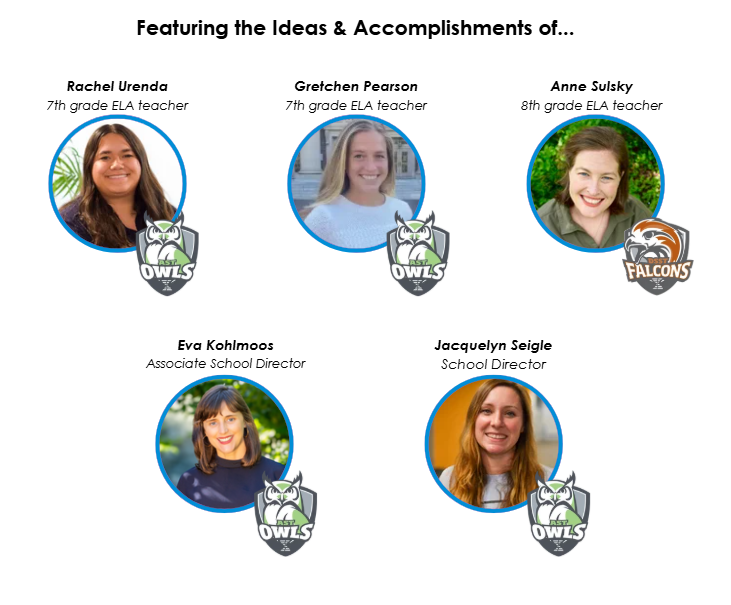
Insights from School Director Jacquelyn Seigle and Associate School Director & Literacy Coach Eva Kohlmoos - both at Aurora Science and Tech Middle School.
The School Director Stayed Close to ELA Classrooms
Jacquelyn Seigle made a deliberate commitment to be physically present in ELA classrooms at least once or twice every week. This was not incidental. It was a leadership priority she protected. She and her Associate School Director Eva described two "alarm bells" that signaled a classroom needed immediate attention: books that were not open, and students who were not writing in them. When she saw those signals, she acted. ELA rooms at AST MS were expected to be strongly paced from bell to bell, with “time in text” and “time in ink” both treated as non-negotiable.
The move to replicate: Commit to a standing cadence of ELA classroom visits. Enter the classroom with the Novel lesson materials in hand. Know what you are looking for before you walk in, and act on what you see.
The ELA Coach Prepared as Intentionally as the Teachers She Coached
Eva Kohlmoos built her coaching practice on a foundation of rigorous intellectual preparation. Her rule was simple: she never walked into an ELA classroom without having already read and annotated the text herself.
Her preparation routine was concrete and consistent:
- The day before, she reviewed her calendar and identified which ELA classrooms she would visit the next day.
- She printed the Novel materials. She didn’t get lost in everything inside - instead, she flipped directly to the relevant inquiry loops, located the annotation prompt and sample annotations, and copied them into her text. She then placed the lesson plan directly inside her copy of the book.
- She walked into every classroom ready to be side by side with the teacher, not observing from a distance.
- Because she had internalized the lesson herself, she could coach teachers to when instruction needed to shift.
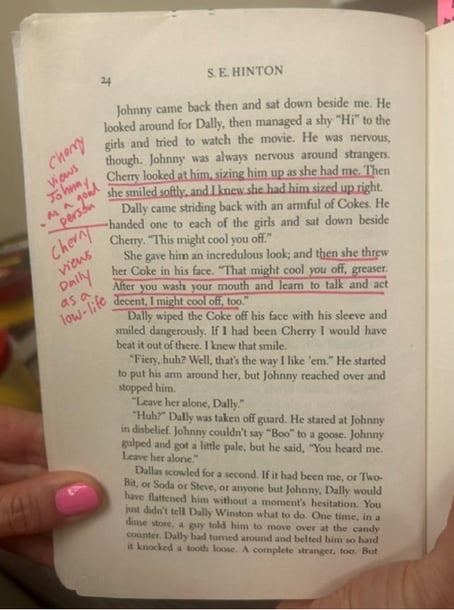
Eva captured the annotations in her own copy of the text before every observation.
Eva’s coaching meetings were equally structured. She wrote the agenda before each meeting and took notes during her observation that she leveraged in her meetings. During her time with teachers, they would routinely identify the most critical lessons coming up. These are the lessons they’d prioritize for Lesson Internalization Coaching Meeting (LICMs) and Hip 2 Hip coaching during class. Data meetings were routine and teachers had clear expectations for preparing ahead of time. If meetings were missed, they were rescheduled. No exceptions. Eva was in every ELA classroom every week.
The move to replicate: Before your next classroom observation, follow Eva’s preparation routine. Read the text and prepare the annotations. Print the lesson materials and have both the text, and the plan in your hand while you observe.
.png?width=637&height=402&name=Copy%20of%20ELA%20Bright%20Spot%20Summary%20(1).png)
Within each inquiry loop in the Novel lesson plan, you will find an annotation chart like the one pictured here. This chart captures the key ideas from the text, the evidence students should be finding to support these ideas, and comprehension scaffolds like back pocket questions or prompts to send students back into the text if these annotations aren’t showing up on their page while in “Time in Text”
Writing Was Made a Schoolwide Responsibility Through Shared Tools and an Intentional Rollout
Jacquelyn and Eva did not leave cross-curricular writing to chance. They built shared language and tools that crossed content areas, and they rolled them out with structure and follow-through.
A key tool they launched school wide included “CUPS” - A metacognitive editing tool students used to review their own writing. CUPS stands for Capitalization, Understanding (read to myself), Punctuation, and Spelling. They introduced this simple and catchy writing acronym using the following structure:
- All staff introduction at Wednesday PD: After leaders launched the what and why of the strategy - teachers broke into department teams and everyone left with an anchor chart they created, and was to be displayed in their classroom.
- Leadership Team walkthroughs: leaders walked together to look for the tools in action. They celebrated what they saw through their school memo, public shout outs, and in real time. Every leader on the team was positioned to walk into a room and remind students to leverage CUPS to improve their writing.
The move to replicate: Identify one writing tool or habit that every teacher in your building, regardless of content area, can teach and reinforce this year. Roll it out with structure, follow through on walk-throughs, and make the bright spots visible.
.png?width=486&height=637&name=Copy%20of%20ELA%20Bright%20Spot%20Summary%20(2).png)
Intentional Teaching Drove the Results
Expert instructional moves shared by Gretchen Pearson & Rachel Urenda from Aurora Science & Tech Middle School, and Anne Sulsky from Cedar Middle School.
Visible Planning Eliminated Zeros
Anne Sulsky at Cedar MS identified and solved for one of the most persistent problems in writing instruction: students who leave the writing task blank. Her solution was to make planning visible, structured, and non-optional.
Anne built her classroom around the RAP Plan: Rewrite the prompt, Analyze the prompt, Plan your response. Before students wrote a single sentence, they completed a RAP Plan that gave them a clear purpose for reading and a roadmap for writing.
Key features of how she implemented this:
- RAP Plans were graded as formative grades alongside ANET benchmark assessments, and students became deeply invested in completing them well.
- If a student did not complete a RAP Plan during an assessment, they completed it afterward. There was no opt-out.
- The result: the number of fully blank responses dropped significantly.
- During ANET, Anne gets coverage for her proctor duties so that she can walk every room to check that students were rewriting the prompt and had their materials in place, gathering informal data and giving proctor directives in real time.
- The entire Cedar team (including science, ELA, and social studies teachers) use RAP plans--it’s a collective effort.
Anne also described the power of writing in front of students and making her own thinking visible. Every time she introduced a new genre of writing, she began with an off-topic exemplar that the class analyzed together before anyone wrote anything. This gave students a model and a mental map before they faced the blank page.
The move to replicate: Teach students how to plan before they write. Make planning visible, grade it, and hold the line on completion.
.png?width=474&height=615&name=Copy%20of%20ELA%20Bright%20Spot%20Summary%20(3).png)
Scaffolds Were Used Intentionally, and Deliberately Removed
Both Gretchen Pearson and Rachel Urenda described a disciplined approach to scaffolding: provide the support students need to access the work, and then systematically take it away as students build independence.Anchor charts, sentence frames, and graphic organizers were available early in the year. As students internalized the skills, those supports came down. By crescendo time, students were expected to work without them.
Rachel described giving students a short graphic organizer for every type of essay, and using scratch paper to draw the organizer aligned to the specific type of writing they were doing, including types the curriculum did not explicitly teach. She graded scratch paper and circulated during ANET testing to observe whether students were using their planning tools.
Anne described a parallel approach: narrative outlines stayed visible on the wall through most of the year, but by crescendo planning, they came down. The goal was always independence, and the scaffolds were always in service of that goal, not a substitute for it.
The move to replicate: Audit your current scaffolds. Which ones are building toward independence, and which ones have become permanent crutches? Make a plan to remove them before the high-stakes assessment window.
.png?width=490&height=610&name=Copy%20of%20ELA%20Bright%20Spot%20Summary%20(4).png)
Teachers taught students different types of outlines to match the type of writing they were doing. Supports started on the wall - and came down as students needed to become more independent.
Assessment Alignment was Treated as an Instructional Imperative
Gretchen Pearson, who also serves as the network's 7th Grade Course Data and Assessment lead, and Anne Sulsky brought a precise analytical lens to the gap between how students were being assessed on ANET and what they would encounter on CMAS. She and her colleagues made deliberate adjustments to close that gap.
.png?width=558&height=392&name=Copy%20of%20ELA%20Bright%20Spot%20Summary%20(5).png)
Key moves included:
- Separating Conventions from Expression of Ideas in the gradebook, mirroring the CMAS scoring structure. This communicated to students that conventions were not an afterthought; they were a scored, weighted dimension of their writing.
- Teaching Conventions with precision: capitalizing the first letter of a sentence, ending with a period, and progressing to transitions as students mastered the basics.
- Introducing multiple essay types that appear on CMAS but not on ANET, including the "Explain Essay," so students were not encountering unfamiliar formats for the first time on a high-stakes test.
- Building timed writing practice into the instructional calendar: after ANET 2, students practiced writing a full paragraph in 20 minutes or less, building both stamina and pacing.
- Teaching prompt breakdown as a skill: students practiced completing a prompt breakdown in under one minute, a habit that required explicit instruction throughout the year, not just during crescendo.
Gretchen also described giving students a specific percentage target for multiple choice on every test, so students always knew exactly what they were working toward. Anne shared an example of a student tracker (linked above) in which students compare their scores on ANET to their scores on CMAS so they can track their progress throughout the year.
The move to replicate: Before your next unit, pull a released CMAS item. Do your students know this essay type? If not, that is an instructional gap to close now, not in April.
Differentiation Kept Every Student in the Game
Gretchen Pearson and Rachel Urenda both described differentiation not as a separate program, but as a daily practice woven into how they knew and responded to each student.
Their most impactful moves:
- Grouping students into three tiers for writing (Grade Level+, Approaching, Significantly Behind) with individualized goals for each group. Special education teachers were aligned to these goals and knew exactly which students they were supporting and how.
- Differentiating writing expectations without lowering the bar. Gretchen described adjusting the complexity of the writing task while holding the same standard for effort and completion.
- Staying close to the students who needed it most. Gretchen described consistently visiting the students she needed to "keep in the game," checking in during independent work time to support task initiation and task persistence, the two skills she identified as most critical for students who were furthest behind.
- Using frames rather than sentence stems. Frames give students a structure to work within while still requiring them to generate their own thinking, rather than simply filling in a blank.
- Knowing which part of the text mattered most for each student to access, and directing their attention there deliberately.
The move to replicate: Name your three students who are furthest behind in writing right now. Do you have an individualized goal for each of them? Does every adult who works with them know what that goal is?
A Final Word: What These Teachers & Leaders Believed
Across every interview, one thing was consistent. The leaders and teachers who drove the most growth held a deep, unshakeable belief in their students' capacity to do hard things. They did not lower expectations when students struggled. They added structure. They added support and they kept students in the game. When students experience success early and often, the motivation will follow. That belief is not a strategy. It is a foundation, and every practice reflected here was built on top of it.